Clients Deserve The Right to Say "No"
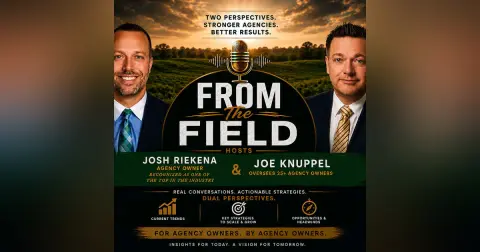
Joe's got a question that keeps him up at night: if your agency just decides life insurance or financial services isn't a priority, are you still actually serving your clients? He and Josh go deep on why agents avoid certain products — spoiler: it's almost always fear or lack of knowledge, not the client's wallet. They dig into the moral obligation of being conversant in what your company offers, how leaders should set minimum standards, and why joint work is the cheapest education in the ind...


Joe's got a question that keeps him up at night: if your agency just decides life insurance or financial services isn't a priority, are you still actually serving your clients? He and Josh go deep on why agents avoid certain products — spoiler: it's almost always fear or lack of knowledge, not the client's wallet. They dig into the moral obligation of being conversant in what your company offers, how leaders should set minimum standards, and why joint work is the cheapest education in the industry. Plus Josh's take on the "threshold" — once you've closed a big case, nothing below it scares you anymore.
Timestamps:
- 0:00 — Intro
- 0:26 — The Question: Skipping Product Lines
- 1:10 — Why Agents Avoid Certain Products
- 3:08 — Josh's Take: Basic Obligations
- 5:58 — Education & Leadership
- 7:46 — The Power of Joint Work
- 11:27 — Closing & Contact Info
Hit us up: ftfquestions@gmail.com — find us on all platforms as From the Field.
Being an agency owner isn't for the faint of heart. Strategy, market conditions, building a team that lasts. This is From the Field, where Josh and Joe help you do it all without losing your mind.
SPEAKER_01Welcome everybody to another episode of From the Field. I'm with my boy JR and what is happening your way today? Beautiful day in the neighborhood, buddy. Beautiful day. You're like Mr. Rogers of the podcast.
SPEAKER_00Yeah, something like that.
SPEAKER_01For sure. Maybe I should take my shoes off and put some slippers on just to start us up. We may have to dress like that one time. I think that would hit hard. I'll get a cardigan out, bust out cardigan season. Oh, that's hilarious. Okay, so let's hop into today's topic. So uh I picked a topic here to talk on, Josh, that that really keeps me up some nights, but I'm not sure. Maybe I'm not looking at it the right way. But the idea is can we truly serve the clients to the best of our ability if whatever our platform is based on the company that we're with, if we just decide specific lines of business are not going to be a priority. So let's take a company, for example, they got financial services, life, home auto, commercial, um, any variation of that or additional lines. But somebody just decides, you know what, I'm not going to even even look at the financial side, or I don't think life insurance is important. So I'm not going to talk about it. Can we miss a product line and still do a good job of serving the client? That's the main thing I want to talk on today. I'm going to give my two cents and you may have a totally different take. But to me, I think I think we have to identify, especially in this competitive atmosphere, I think we have to identify if we avoid a specific product line, why is it that we're avoiding it? Is it a lack of knowledge? Do we not have confidence? Do we truly not believe in that product? Um, you know, there's something in there that tells us. So sometimes I'll I'll hire somebody that's, you know, 22 years old. And the life insurance discussion is a tough one because they've never lost anybody and they they've never seen what it can do. So, you know, it's kind of built in because they haven't had the experience. But I had one not that long ago where we kind of peeled the onion back, and the individual told me on the financial side of the house, I I couldn't figure out why, just absolutely avoided the conversation with every client. And then finally she said to me, I do not want to be responsible for people to work their entire lives. And if all of a sudden the market tanks one year, I feel like I'm the one that did it. And it's like, okay, great, now we've got something, something to work with. So going back to that, I feel like you either have to become interested, knowledgeable, get training on that specific area, you have to bring somebody in that's going to be a specialist when it comes to the area that that you lack in or that you're not concerned about, or you have to know your resources, which a lot of companies have got tremendous resources for all the different areas. So maybe you're not the expert, but you know how to uh position that expert inside of those appointments. So I feel like you've got to do one of those three because I don't feel like clients should be at a disadvantage because we as agency owners decided something's not a priority to us. So what are your thoughts on that?
SPEAKER_00Yeah, I mean, it's a tough one, right? Is that that the moral, is there a moral obligation to have a basic knowledge of these certain things? And I think it's tough because what does the general client expect when they walk into an insurance agency office, right? I mean, probably car and home. I think everybody could agree that's that's probably a basic, they assume that they can handle that there. But then where does it cross over into financial services? Do you are you obligated? We've all been to that sales meeting, right, where the the district manager gets up there and is like, you have an obligation to your families that you serve. And and and people kind of go, you know, do we like I don't want to be pushy because it there's that line. I believe that there's a reasonable expectation that if somebody's talking to you and you are an insurance agent, they assume that you're gonna talk about auto home and probably life insurance. Okay. I think that's that's pretty inside the scope. When you really get outside of that, like if you're doing specially commercial or should you be an investment advisor, I think those things, there are other places they could go to for that. Like I don't think that's their the general, like the middle ground assumes that you're gonna be able to talk about complex financial stuff. But I mean, you you owe it at least like it's not a sales shtick to say like you should be conversant in basic insurance. You know, auto home life. You should be able to bring up some of that. But I do, I think you're nail on the head. People are either scared or the easiest thing to do if you don't understand something is bash it. Yeah. The easiest thing to do is be like, that's stupid. Like that's that's a bad product. Uh I saw a video one time where somebody said that's that's bad. So I'm just gonna take their assumption and use it as mine. So I think I think every person has to navigate this themselves. I see why it weighs on you, because there's no black and white answer. Like, we should have everybody for this or every person should fit into this. But I I do think it's a worthwhile discussion to think like, what are the basic obligations we have? Like if they ask about a product, should we be either knowledgeable enough or or put them in the right direction?
SPEAKER_01So let me ask you a opinion and put yourself in a in a leadership role. If the pushback that you get, instead of being introspective and saying, you know, I'm not comfortable talking about financial services, or I'm not comfortable talking about life insurance, if the pushback is the clients, the clients don't have money to spend on life insurance in this economy, uh, everyone's got it through work, no one wants to talk about it, or whatever the arguments are going to be on the financial side, which we could come up with a long list, if if it's always diverted to the client and why they either don't need or don't want a product versus saying, I'm not, I'm not comfortable or I'm not well versed enough. So therefore I can't move my practice forward. How would you approach that if you were an agency leader?
SPEAKER_00Yeah, I mean, education has to be part of your growth, right? Whether we talked about getting better or anything, you should always be getting better and more knowledgeable, whether you're blocking off an hour for professional development or getting with a mentor or joining a study group in this. Like, if you're gonna do this, you you you better do this. Like, don't just uh I know renters insurance or I know car. Like that's lazy. Like you should always be getting better. I do believe we have a basic obligation to to at least offer the services offered by whatever company you represent. I think I think that's it. Like if your company offers that, you should you should at least make a basic offer of it. Like, I'm MDRT, done court of the table, you know, how many years we've done it. I don't care what type of life insurance they want to take. It doesn't bother me. I have no bias towards any of them. I mean, I I've had term life insurance policies, tenure terms pay out for you know millions of dollars that have kept a family in their house. And we've done expensive long-term planning policies that, you know, some people say, well, that's a waste of money, that's this. But the client, this is what they want, their attorney suggested it even. So I don't have a bias against either one, but that's comes with a depth of knowledge. I think you need to study to at least a basic level if you're gonna be out there representing people, because there's an awful lot of people who truly haven't been offered anything. And everybody kind of uses the guise of like, oh, I figured their financial guy did that, or their, you know, their life insurance girl did this. And then these people never get an opportunity to do anything. So you have an obligation in the industry to at least do that. And as a leader, we need to be you know, setting the bar at this is the minimum level that your client should expect if they walk in the door and and almost the rules of engagement, right? Type thing. Like if you're gonna work here, these are the minimum things that we're going to offer and at least be conversant about.
SPEAKER_01Yes, and as you just said, the knowing they'll have the opportunity to say no is great. I mean, either way they go, just getting the opportunity. I've got one more question for you. I know you have been um, you know, uh fundamental piece for for several reps throughout the year when it comes to uh running joint work. So I I have watched people that have come to you working jointly and all of a sudden they become very proficient on their own. So talk me through what your thoughts are. Did you ever have joint work when you were up and coming? And when you run and have joint appointments with reps that maybe struggle in those specific areas, do you see them then go to another level because they've actually seen them modeled and seen what wins look like?
SPEAKER_00Yeah, and I mean, it's the cheapest education you can get, right? Is joint work. That's what my mentors told me when I came in. You know, I had my uncle, I had I had Mike Weber, you know, legends in the industry. And they always said, hey, it's the cheapest education you can get. Whether you're on either side of it, right? You're getting half of it, you're getting this, something you wouldn't have had. The one thing to remember, and I remember this when I was really early, I wrote, you know, a larger case, you know, the the typeware. And it and if anybody's ever done this before, you know what I'm saying. You put the check in the passenger seat and then put the seatbelt around the check and then drive it down to the mothership and walk it in and say, can you please apply this? And they they shake your hand and thank you for the the business. That was that was the one I'm talking about here. Once you've worked on something to that level, everything below it doesn't scare you anymore. It's a it's a weird phenomenon. I work this with my associate agents. These are people that are new in the business. And at first they're scared to talk about $50 a month, you know. And then all of a sudden they'll work with a client that walks in, you know, and they do a $300 a month policy. And now they're not afraid to talk about anything below that. It's like you're whatever threshold you get to, now everything below it doesn't scare you. So that's what joint work allows you to do is to borrow that experience and expertise from somebody who's already been there who isn't worried about those numbers.
SPEAKER_01Yeah, that's right on.
SPEAKER_00I I think it's the quickest way to run up the hill, right? Like just latch onto somebody else, get the experience, see how to do it, develop theirs and steal their ideas, right? Like procedures, we're not making up new things. Like we're hearing great ideas and we're adopting them to our own practice.
SPEAKER_01Yeah. And I've walked out of of individual client appointments and put them in a much better position and celebrated alone. And I've done it jointly. And it's way more fun to high-five uh somebody when you get away from the house because you're so excited at what you did and what you actually brought to the client. Um, it's a fun time. So I think that's the other thing.
SPEAKER_00But so I've seen what you developed on on you know, how to come up with the number and your life insurance number, these kind of things. I've seen you do that. I've always enjoyed watching you do what you do. But one thing I want to tell anybody listening is there is a weird thing. If it's not your client, you're just coming in helping on the joint work or or that. It's so easy to be clinical about it, right? Like you don't have any bias. You don't know that Jim lives down the street or they go to the other high school or whatever. You're just like, oh, based on this, this is what I recommend that you would have. You know, it's so easy if you don't, if you're not too in the weeds with that customer. You don't know they had a claim they were mad about. You don't know that their kid just turned 16 and it raised their insurance $100. You're going, this is pretty obvious to me. This is what you need and this is why, and here's the math. Yeah. And it's it's easier to do that. And the other side of the coin is like the person that comes in, if if you know, I'm sorry, if the client knows that you're bringing in an expert, they view their opinion different than Joe Schmo that's been their, you know, car insurance deductible guy for the last 10 years. For sure. So there's a lot of benefits to bringing in an expert on that, not only from your education, but also with the client experience.
SPEAKER_01I appreciate you sharing that. So thanks again for joining. We love your feedback. So if you want to reach out to us at ftfquestions at gmail.com, we like to build out all of our episodes around the things that are concerned to you. You can find us at From the Field Podcast on the other platforms. And anything you want to close with, Josh. No, appreciate everybody.
SPEAKER_00Enjoy the feedback, keep it coming. Uh, this is what makes it fun.
SPEAKER_01Awesome. Have a good day.