"Episode 6: Green Flags, Red Flags: Where To Find Your Next Great Hire"
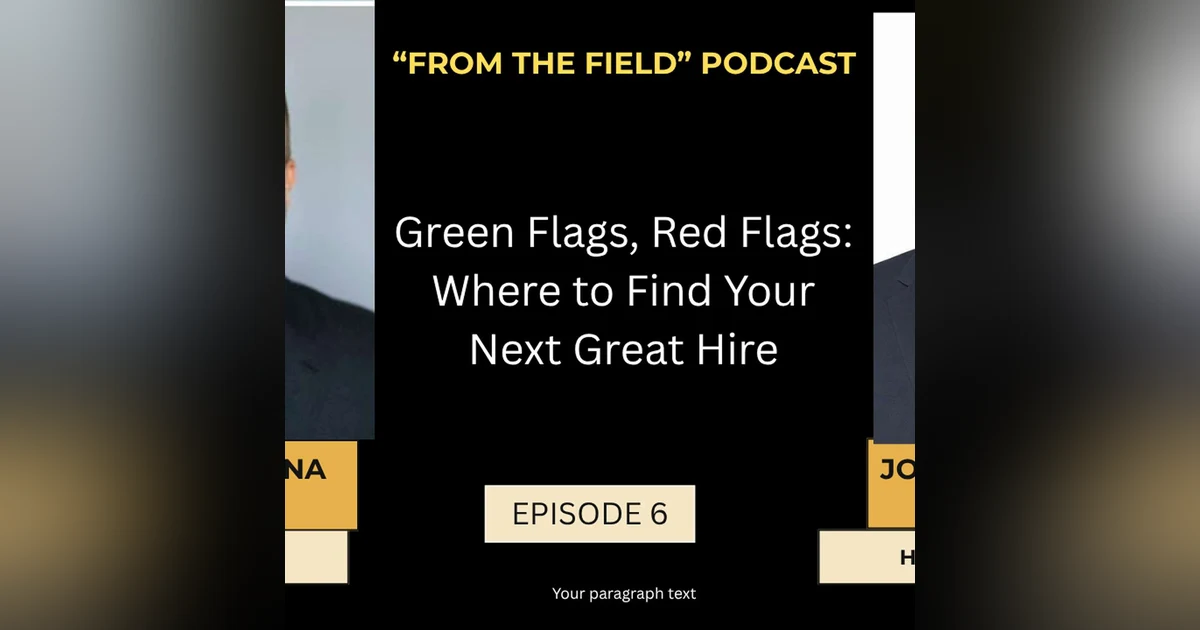

Josh and Joe get real about hiring — the good, the bad, and the "how did I miss THAT" ugly. From how JR finds his best people to the sneaky AI trick candidates are pulling in interviews, this one's packed with hard-earned wisdom for anyone building a team. Chapters: 0:00 – Intro0:51 – How Josh Finds His Best Hires — spoiler: it's rarely job ads3:12 – Characteristics of Great Employees — what "hardworking" actually means7:13 – Accountability and Coachability in Interviews — the pushback test10...


Josh and Joe get real about hiring — the good, the bad, and the "how did I miss THAT" ugly. From how JR finds his best people to the sneaky AI trick candidates are pulling in interviews, this one's packed with hard-earned wisdom for anyone building a team.
Chapters:
- 0:00 – Intro
- 0:51 – How Josh Finds His Best Hires — spoiler: it's rarely job ads
- 3:12 – Characteristics of Great Employees — what "hardworking" actually means
- 7:13 – Accountability and Coachability in Interviews — the pushback test
- 10:52 – Financial Red Flags to Watch For — money habits don't stay at home
- 13:05 – Pre-Work Assignments as a Hiring Signal — the ones who half-ass it, tell you everything
- 14:57 – AI in the Interview Process — when candidates sound too polished on video
- 17:54 – Trusting Your Gut and Learning from Bad Hires — plus a wild "ghosted after onboarding" story
- 20:13 – Always Be Recruiting — even when you're not hiring
- 22:45 – Hiring from a Position of Strength, Not Desperation — beware the "hiring beer goggles"
- 24:54 – Closing Thoughts
Being an agency owner isn't for the faint of heart. Strategy, market conditions, building a team that lasts. This is From the Field, where Josh and Joe help you do it all without losing your mind.
SPEAKER_00Hey there, and welcome to the next episode of From the Field Podcast. We're sitting here on a Friday morning about 8 a.m. and we've got the uh the Midwest football season firing up, as I can see with you, Josh, you know, sporting your Dunlap sweatshirt.
SPEAKER_01Hey, tis the season. There's nothing like Friday night lights in the Midwest. So we uh we kick off tonight and are excited. I don't know when this is gonna air, but uh, you know, hopefully our record is is is is good at that point.
SPEAKER_00Well, it seems like you guys always dominate, so I'm sure it'll be another good year. Let's hope, let's hope. Yeah, fingers crossed. Well, hey, kind of jumping into it, you and I had had a conversation that led me to wanting to have this session. So uh we've talked in the past, but you've done a phenomenal job of scaling up your team and having high quality people uh inside of the agency. And so I was I was talking to you and I had I asked you a question thinking I knew what the answer would be. And it really came back to where's that next hire coming from? Right. And and I knew what I thought you would say, but actually your response uh kind of caught me off guard because you kind of source people in a different way when it comes to who you who you're adding. Um, can you talk me through kind of what you're looking for and where you're looking at?
SPEAKER_01Yeah, I mean, it's different even than I think, you know, internally, I think I know where I find people. Like we think we recruit, we think we do all this, but if you really look around my office, um, everybody but one person I knew before they started working here, you know, through an interaction, through somewhere. If you go around the room and I'm just kind of virtually looking out in the office, right? Like my operations manager, I worked on a not-for-profit with her. You know, I didn't even know what she did for a living. We didn't even have a job for her when we tried to get her to come on here. My wife just said, Hey, we we want, we want you to work here. She's like, Well, what would I do? And we're like, we'll find something. Like it was just, it was the person, not the position, right? The the guy running my associate agency team right now coached my kids when they were little itty bitty four, five, six-year-old swimmers, right? The little club swimming team you could send them to. Um, so I saw the way that he interacted and coached and did that and uh you know that. We have four former client or current clients, but they started as clients before they ever came in here and worked here. So they they saw the business from the inside, they they experienced it as a client and then wanted to work here. So, you know, you think you go out there and you have all these ads and you're you're you're paying for boosts and you're out there on on you know, Indeed or wherever you are, and and that's where they're coming from. But when you really look at who sticks, it's not necessarily true. And you know, I I think what happens is we might be walking past our best possible candidates uh and team members all the time. Whether it's somebody that, you know, I I think of the restaurant, right? You go there and just had a great experience. What the food is usually part of it, but it's usually just part of it, right? Usually it's somebody taking great care of you. And that person that changed a regular experience into a great one, you know, that has all the skills that we need here to improve a client experience.
SPEAKER_00That that makes sense. So do you see specific characteristics that have trans really kind of um translated into somebody being effective on your team? Because sometimes when I look at my role, hiring agency owners versus your role, um, I see a few things that stick out as uh as differences, even though we've had more similarities than differences. But whether that be financial position coming in, because the investment tends is going to be more on my side than than yours, the ability to kind of go into your system, right? Because your system is set and you need somebody that can that can plug and play and then add value where sometimes I have to start from the beginning with that. Um, those are a couple that come to mind. But are there are there specific characteristics that you're seeing that you could say this is this is a good indication?
SPEAKER_01Yeah, you know, you read resumes, right? And everybody always says hardworking, dependable. Like I think everybody puts the same things at the start of their resume. And it's like, but but hard working has a different definition, I think, with a lot of people, because there's people that will, you know, I I'm I'm I'm I'm always on time, I'm hard working, and they'll roll in one minute before work starts. And you know, at it at 5, oh, oh, oh, oh, they are on the way out the door, right? Everything's closed down and they're jumping out. Like their idea of hard work was, I mean, I was here the whole time. You know, I I was there versus there's people that are always looking to exceed and grow. And and when you look at those people and how they interact in their business, it's obvious. Like you can see the person who's just there for the paycheck, and you can see the person that genuinely cares. And what I've found is if we have a bunch of people here that that don't want to let anyone else down, like that's a huge characteristic, right? That you just don't want to let anyone else down. Like that's how I am. Um, I actually like my biggest work fear, right, is that something I do causes more work for somebody else. Like, like I struggle with the ADD. I, you know, I can get a hundred things 85% of the way done, but like zero of them get all the way. So I hire people that are that are good at completing it. But if I work with another person who's like me that also is, you know, going going here a million miles an hour, I found that at least if our if our desire is to not let any walls down, we we tend to work together. Now, sometimes we can cause bigger problems and we have to work together to finish them, but it's that like human element of I want to better the team, not just like what is the team doing for me that I think is a huge characteristic. Now, here's what I think is funny. Like I am hiring junior agents, I'm hiring this. You're out there though trying to find somebody to go, you know, be entrepreneurial that's gonna have to hire people, that's gonna have to go into this new modern, modern world. You know, so I I'm trying to think of it in the lens of for you, you know, what what when you're out there in the world, are you looking at at managers at stores? Are you looking at people that are high-level employees that could be managers? You know, what what are you looking for out there?
SPEAKER_00Yeah, that's a great question. And and you know, I've transitioned to a new territory. So uh a lot of what you're talking about from the standpoint of natural market and people that were around, I'm not really um, I don't really have that ability right now. So I am in a position where I'm working through um different sides, through a recruiter, through my networking, through local centers of influence and in their referrals. So a lot of that when I'm sitting down with people, I've got to try to figure out on my own in the first couple of meetings, which which is as you're saying, can be really challenging. Um and sometimes you just you make mistakes there. But I think I think my hiring process has evolved tremendously the last decade. So if I went back 10 years, when I sat down, it was almost like, can I see myself in this person? Can they sell? Right, which is so short-sighted. Um it's it's unbelievable looking back because that that is what drove a lot of my hiring decisions was do I feel like this person could sell ice to Eskimos? And even though what we do brings tremendous value to the clients, are they persuasive, maybe, right? Right. That's that's exactly right. Um, but now uh you know, after making a bunch of mistakes, which is which is what you do, right? You make your mistakes and you go back to the drawing board and say, was this was this on me? Um, I've changed my approach. So a couple of things that really stick out to me inside of interviews, really accountability is is a huge one. I mean, that's that's a big one. So one of the questions I ask um every single person I interview is tell me a mistake that you made in the last year. How'd you recognize it and how'd you fix it? And if somebody can't come up with a mistake they made, which I have had happen, to me, it's almost an automatic disqualifier. Yeah. Because if you can't, if you can't tell me a time that you messed up or you had a misjudgment and and you're not comfortable enough to to admit that, you're gonna blame everything that goes wrong on all the outside factors, right? There's zero accountability there. So so that's one that I see that comes up all the time, um, that I'm surprised by. The second one, there's coachability. So we want people that are that are independent, right? People that can go out and they can blaze their own trail. But at the same time, um, I uh that's really what I feel like my role is, is to be the the the collaborative partner and the person you can brainstorm with. And um I've got a I feel like I've got a a lot of really good input I can give to help um bring people along. So if if they're unwilling to be coachable, that's a big one as well. So what I do in interviews there is, and this is this was uncomfortable for me early on, but I would find something that they say in the interview, and intentionally I would give a a small amount of pushback to see what they said. Just to see how they handle it, right? Yes. Do they defend their position or do they ask more questions? And I just had one. So I just had one where um I said, talk me through agency ownership. What do you think is is the most appealing part of that? And the individual said, without a doubt, it's the freedom and flexibility. And and there's there's truth to that, right? That's that's a that's a fair, that's a fair answer. But I said, you know, it's interesting because in my experience, people that focus on the freedom and flexibility long term tend to be in a position to where they start cutting corners and they can't hold themselves accountable. How do you feel about that? And it it's interesting to see whether somebody doubles down or they they try to learn more about what you're saying or what you've seen. So to me, coachability and accountability, uh, those two things kind of in line with with what you're talking about. And that is making sure that um they feel like they're doing the right things for the people around them. All of it kind of goes hand in hand.
SPEAKER_01And you're getting a little Ted Lasso on me here. It's like the be be curious, right? Like the answer to that, right? They don't we don't want them to defend their position there. What we want them to say is like, okay, like what do you like? Tell me more about that, right? Like the curiosity part is like, okay, so what happens? We know we already know that story, right? It's the Spider-Man theory, like with great power comes great responsibility. Like right, you can take off as much time as you want, but you've got this. And we know that usually if if you put the uh time off first or the flexibility first before you've paid for it, it doesn't go well. Like it can go well in a short term, but we know darn well long term, if you didn't put the work in to earn that, uh it's kind of borrowed time. And uh I mean we we just know that from our experience, but man, that somebody coming in new, right? They they see it. We all know the stereotype, right? They just play golf, uh, must be easy. Right, I know you know, he drives a Cadillac, he does whatever. Like, we all know that that uh mentality. So no, that's awesome. Well, what are you what are you seeing out there? I mean, like what are the kind of red flags? Like, I I know personally I've run into this. Like, if they have like it's not even issues with money, right? It it's it's if you just kind of see some financial, just poor decision making over and over, it it's kind of like running on E, right? They have no no emergency, and it's just like they continue to make bad financial decisions. They tend to translate that to the office, right? So it's like they use all their PTO early, then they then they're shocked when something bad happens and they need to take time off, and now it's your disaster, right? Now it's your fault. You don't didn't give them more. It's you know, it's it's always a blaming mentality. So I've seen people come from you know very modest revenues to to making a lot of money in this office. For sure. But they never blamed anybody else, right? They came in and and and owned, that was just a situation they were in. And I've also seen people that have had plenty of revenue just making poor decisions. And those are the ones that scare me the most. Because it's like, man, if you if you're gonna make that decision over and over, well, this wasn't a mistake. This is a continual habit. You tend to spend your equity at work the same way. You know, you just burn the thin. And then then when the disaster happens, you ask like, yeah, there's no way you could have seen it coming, and nothing could have prevented, you know, not using all your vacation by April or something like that.
SPEAKER_00Yeah, no, that that's a good point. And you know, on the agency owner side, um, their ability to be able to invest back into the business. Yeah. And and I've got to know if if someone's coming in, um, unless they're flipping a book of business over, uh, if if someone's coming in and they're not really sure how successful they're gonna be in this career, I've got to know that that household really for 12 to 18 months could handle if things don't run well. Now, I mean, companies have done a good job. That's the reality of it. It is, yeah. And the companies have done a good job across the industry of trying to layer in bonuses and ways to enhance commissions and to do different things to offset the cash flow issue. But once again, what we both know we've seen people that for six months barely, barely put anything on the board and then get their feet underneath them and take off. But the question is, can your household you know sustain that? Um, so that's that's one piece. The other one I'll give you that's uh a huge red flag that I used to push back against was uh pre-work. So I have people that do pre-work. They actually have assignments that they do. We do as well. Yes. And and they're not uh they're not assignments that you can just do on your own, you know, sitting watching Netflix at night. Like you've got to go out and talk to people and it's gonna take some effort. And it used to be I would look at that as kind of a rock, even from the standpoint of hiring, because it's like, oh, this is gonna set this person back 10 days. Like, I I know they probably don't want to do this. And I looked at it totally wrong. And now what I find is the people that are on top of those assignments, they learn things from them. Um, when you talk about them, they get excited and talk about you know what things they discovered and they're timely, those are really good indications. The people that just half ass those or they don't do them at all, it's almost always an indication that later on you're gonna have a problem.
SPEAKER_01Yeah, if you're gonna come in that way, the the odds of you then just just it's it's kind of like you're gonna have a bad practice, but don't worry, you're gonna turn it on during the game, right? Like that's it. Man, you look at these kids, you're like, you just think you're gonna turn it on on Friday, that it's that's not how it works. Like you earned that. Friday should be easy because you worked your butt off for the last, you know, 300 days. Yes. And if you think you're just gonna kind of go, oh, and then on Friday, you're just that's gonna go full speed. So you're gonna do your assignments half butt, but then you're gonna show up and be good.
SPEAKER_00Yeah. Sure. I believe that's a great that's a great analogy for sure.
SPEAKER_01Well, question. I got one thing. You led me into something too. So you go first. No, go ahead. Go ahead. So my my question here is like I've had that happen, right? I I I've had the person, you know, that I've sent the the the stuff to and they've done the pre-assignments or they've they've we do video interviews. I use a third party that kind of vets resumes and then uh and then they do a video interview where they answer five questions. And it I'm starting to get the feeling that uh people are using a little AI assist nowadays. Like I'm getting a real big vibe here um when people are applying for like junior agent roles in my office or something, because they'll knock these questions out of the park. Like they're they're thoughtful, and it's like, man, they really researched our company, they researched my agency. Like these are great answers. Yes, and then they'll come in in person and they can't even put a sentence together.
SPEAKER_00Yes.
SPEAKER_01And I'm like, well, okay, maybe they just were got nervous, right? So I'll hire that person, which was a mistake, but I'm like, man, they just crushed that video, so I know they can communicate well. I think they just got nervous. No, no, no. I think they used AI to answer the questions and then read them back to me on video. And I'm I'm starting to get concerned. Like, what are you seeing? Are you seeing people using AI to kind of bypass those assignments and that and just kind of come in and go, hey, look how smart I am. And then you're like, whoa, wait a second. This doesn't match this.
SPEAKER_00And that's why, like our assignments, you couldn't use AI because you actually have to talk to people. But without a doubt, I mean, people are so well versed now that you and I both know I could just say, hey, uh, I'm interviewing for a an insurance position next week. Um, give me the top 15 questions that tend to be asked, give me the best responses. And I can I can now spend 30 minutes and go in and pre and and sound like I know what I'm talking about. So a hundred percent true. And I and I think, I think to your point, um uh there's a lot of hiring that's intuitive, especially if you've done it for a while and you're and you're ingrained in the industry. And you talked about red flags and you talked about the the intuitive side for it's strange, but but people can't really offset that. You get a gut feeling for people. And what I've found over time, not always right, right? There's there's times where I've said this person is gonna set the world on fire, and six months later, um, I'd give anything to go back. You know what I mean? But um, but the opposite uh I have found I'm almost never wrong. And that is if I've got a gut feeling, even if they're answering things the correct way, um, there's just don't believe it. No, I just I just know that this this one red flag or the feeling I'm getting, this person is not gonna fit inside of our team. Yep. Um most of the time that that should be a no-go. Because if you don't, what ends up happening is down the road, you end up kicking yourself. But to your point, when it comes to people being well versed now, it's harder than ever. You've got to be able to dig into, um, like you said, if you can, if you can observe somebody in the wild, the, you know, the the manager at the at the the restaurant that's making sure every table's taken care of, that's multitasking, that that really cares about the the customer experience. You when you can see someone in the wild, that's that really carries weight. When you're just giving people canned questions, there's a lot of people that can that can pull one over on you.
SPEAKER_01Yeah, I'll tell you. And I think this is something too that you know, if there's one thing that's cathartic about you and I talking in that, and and if anybody's you know watching this and and and looking at and interacting, it's like we've all made mistakes hiring. Like, and what I don't want to do is I think some people get burnt and then don't go back to the wall. And it's like, look, it it necessary evil is a probably not the right term, but like we have to grow, we have to recruit. And I think that constantly recruiting versus when you need it is a huge difference. So I think that, you know, if you're if you're out there and you've been burnt, if you've hired that person Joe's talking about, a person I'm talking about. I mean, I had I had somebody come in a year or two ago with a resume that was impressive. And I'm like, man, all right. I we came to an agreement. We brought this person in for our annual meetings, we introduced them to the team, we had an onboarding date, everything was set. I mean, we ordered a laptop, we got an ID, we got a passport, everything. This person was part of our business plan. And then I get an email. Hey, sorry about that. Uh, the place I'm at right now when I told him I was leaving, gave me more money. Okay, it's not gonna work out right now. And it's like, wait, what? Like you were driving here, like you approached me, like I didn't go after you. And in this, I mean, and I'm like, where did I where did I miss? You know, I mean, it was on, but you the very next person has been with me for over a year now and is crushing it, and he's making great income and his family's in a better position. So, like, I wouldn't have him if I'd had the first one. So, you know, what I would say is just don't don't get off the horse just because one thing happens, you know. I mean, we we are gonna run into these crazies and it happens. And I, you know, if anybody has one, we'd love to hear a couple good ones. Sometimes it's just good to scream out in the in the abyss that is the internet and say, you're not gonna believe what happened to me. I hired this person, this happened. But we could probably go on for hours about the crazy ones, right? But uh what I would say is, you know, especially if you're if you're new or if you're growing, like don't be discouraged if you made a bad one. Like there, there are people that just you can't you can't see the camo. I mean, they they they they get in your door and then you're like, whoa. Yeah.
SPEAKER_00Who did you send to interview? Because that's not you. No, no, that that's that's uh that's right on. And you bring up something I I want to ask your opinion on real quick because I think it's so important. And I'm curious if this has changed over the over the last 20 years for you. And that is you talked about always recruiting, like wherever you're at, always recruiting. And you know, I I think sometimes, especially early in your career, when when five o'clock comes and you leave the office, you're done, right? So I mean the the the work's behind you, you're not in you're not in work mode. But as you develop, sometimes that changes where you're always on the lookout. Have you found with with your own agency that when it comes to recruiting and um looking to see what's out there that you're always on now? I think I'm more aware.
SPEAKER_01Like I think I you know what I mean. And in and remember, it's not always about like, hey, do you want a job as an insurance agent? You know, it's like, whoa, like, you know, and and we know we know Troy's saying about, hey, you know, I have no reason to believe you're looking, but if you ever wanted an opportunity to have more fun and make more money, right? Like that that soft introduction that we love. And we love Troy for for originating that and showing it to us. But ultimately it's, hey man, I'd love to, I'd love to hear more about what you do. And a lot of times we'll just have a coffee or catch a beer or just, you know, we'll be at a ball game talking to somebody in the community and just hear more about what they're currently doing and and just keep that relationship open that if anything ever changes, you'd love to talk with them. And I think that that's really what you need to have is 20 of those people, hey, if anything ever changes, you know, I'd love to talk with you. Um, and and there's nothing wrong with, you know, interviewing when you don't have an opening. Uh, you know, my my team for Q4, uh, we shared going into this year that we had a growth model to add another junior agent in Q4 of this year. Like that was shared with our sales team. Everyone's aware of this. We're not stepping on anybody's toes. We have two candidates right now in Q4 that we met as a team at our association. Agent meeting and I said, Hey, like any objections to bringing both on? You know, we have two candidates that that kind of presented themselves, whereas originally it was supposed to be Q4 for one, and then we were looking at Q2 of 27 to bring on the next growth agent. But if we had two people that came in at the same time, is that a bad thing? Like, is it a bad thing to bring them both on right now? And you know, there was an overwhelming support for it if it's the right person. And I think that the more you're in the industry, the more you know is person is probably more important than the position. You know, it it's about having good people on your team and then figuring that part out. Sure.
SPEAKER_00Yeah. You you know, you bring something up that that I just want to touch on really quick. If I look back over the course of all my hiring years, hands down, the weakest hires, I have been backed into a corner time-wise because of being in a position where I had I had to have a manpower hire, right? So on my side, it might be it might be corporate pressure where I need to be at a certain number. You may have a specialist role that all of a sudden is open and you don't have people on the bench. So now all of a sudden, when these when the when you interview these red flags, they're not red. They're like, they're like pink. Maybe they're slight white, right? You just they look a lot better through that lens, right? They do. Yeah. So to your point, I think that is enormously important is the fact that you've got the bench and that you're hiring from a from a position of I don't I don't need you right now. I need the right person when the time's right, but it's not the fact I got to get somebody in here by the end of the month. Yeah, it's the the hiring beer goggles, right?
SPEAKER_01Like all of a sudden everything just doesn't seem so so different. And then once you get in the light of day, you're like, why did I I must have been pretty desperate. But but reality is, right, there's an old saying, like the the best time to interview for a job is when you don't need one, right? And there's a reason for that. It's because of you're just you're just honest, you know. And I think that that's true on the hiring side, right? The best time to be recruiting is when you don't absolutely have to have someone tomorrow. Right. Because you're you're hiring from a from a need and necessity, not from a growth opportunity and a plan. So, you know, for us, we always believe in in, you know, kind of like pre-pre-hiring, right? Like, hey, we were almost to this metric, now is when we do. And I know we have a segment coming up on when to hire and kind of the the triggers that cause that and using some limer statistics to back it up. But you know, generally speaking, if somebody good comes across your path and you know, you think that they would make an impact, find a way to get them on. Right. I mean, let's not miss that opportunity because you you weren't planning on hiring somebody for another night, you know, 90 days.
SPEAKER_00Yep. Oh, that's right on. No, I think that's perfect. And I know future episodes, like you said, about when to hire, we've got a lot more kind of offshoots when it comes to hiring, and we've got some great industry experts uh in that field that we'll have in the future as well. But anything else you want to add before we shut it down?
SPEAKER_01No, I mean, I just uh appreciate everybody tuning in. Uh Joe, I appreciate your time always. I mean, what a unique perspective to be able to kind of, you know, we always talk about as owners, like, oh yeah, I'm hiring this position. Like, you're hiring us. And so, you know, in and all kinds of people can work as agency owners. Like there, there's no size seven shoe of what an agency owner looks like. You know, it can be anybody. So, and I think the same thing is for anybody on our team, you know, we're looking for for a person with these kind of characteristics, not a template. You know, I'm not looking for any specific, like I can't look down the street and say, oh, I think that would be an like I'm looking for how they're acting, you know, and in what they're bringing to the table, not in anything else. So I just think it's unique. I think we're at an opportunity inflection point in the industry where people have, you know, you know, there's there's a lot of growth you can do right now. And if you bring the right people on and put them in the right positions, they do well, you do well, you know, everybody does well. And and we all need good people right now. I mean, that that's just the bottom line. We need good people in our corner working with us, and you know, I think that's what we should all strive for.
SPEAKER_00Uh, that's right on. And as always, we appreciate you hopping on and and watching and joining us today. If uh if you have anything at all on the hiring side that is one of those things that you just can't come up with the right answer and you want to throw it in the comments, Josh and I will come together and we'll make sure that we get that answered or we could even have a session on it. So please don't hesitate to share. And as always, we appreciate you being here. Josh, good seeing you and good luck tonight in the football game.
SPEAKER_01See you guys, roll leagues.
SPEAKER_00All right, see you now.
SPEAKER_01Take care.